

Eliza Billingham
/
Iowa Public Radio
Fatou Traore was granted humanitarian relief in the U.S. due to a high risk of violence against her in Ivory Coast. In September, she was pulled out of her car by unmarked immigration officers. Now, she's in Sierra Leone, where officials are likely to send her back to her birth country.

Madeleine Charis King
/
Iowa Public Radio

Courtesy of the candidates
-
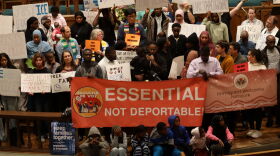 Fatou Traore, an Ivory Coast native who has legally been living in Iowa City for two decades, faces imminent deportation to Sierra Leone. Supporters rallied Wednesday night calling for her release, and U.S. Rep. Mariannette Miller-Meeks sent a personal letter to the head of Homeland Security asking for a stay on the deportation order.
 -
 Many Ukrainians who fled the war with Russia found safety in the U.S., including in Sioux County. But for some, staying in Iowa is far from certain, as a deadline for temporary protected status expires next month.
 -
 Afghan soldiers stood beside American troops for 20 years. Now, five years after the evacuation, many still don't know if they'll be allowed to stay. On this episode, we take stock of what's happened since roughly one thousand Afghans resettled in Iowa. We talk with Fatima Saidi, national director of We Are All America and Robyn Barnard of Human Rights First. We also discuss what today's shifting immigration rules mean for Afghans still in limbo. Then, we talk with Cate Dicharry, the new director of the University of Iowa's International Writing Program. It’s been a year and a half since federal funding cuts threatened the program, and we discuss what its future holds.


-
 Indianola is the third city in Iowa to discontinue its use of Flock cameras after controversy over who has access to the automated license plate readers’ data.
 -
Are America’s divides truly political — or is something else at work? In his book 'Nations Apart: How Clashing Regional Cultures Shattered America,' historian and New York Times bestselling author Colin Woodard argues that today’s polarization can’t be explained by Democrat/Republican or urban/rural divides. Instead, he traces these conflicts back to regional worldviews rooted in the nation’s earliest settlement patterns. (This show was originally produced Nov. 25, 2025.)
-
 With most foreign students paying full tuition, campuses will lose out as the numbers of international students decrease. Meanwhile, students worry as new restrictions about how long they can stay in the U.S. are set to go into effect.


-
 For the second time in less than a year, the Decorah City Council unanimously rejected a separation ordinance that would have limited the northeast Iowa city’s cooperation with ICE. Council members said the move would’ve made the city a target for state retaliation.
 -
 Immigrants in Iowa, Kansas, Missouri and Nebraska are being detained for months at a time, waiting to be sent to countries where they have no ties. Some have criminal records. Others came to the country seeking asylum.
 -
The Supreme Court just finished one of its most consequential terms in years. Drake University law professors Sally Frank and Miguel Schor break down what the 2026 rulings mean for Iowans. They discuss the landmark win for birthright citizenship, the loss of deportation protections for hundreds of thousands of immigrants, new limits on transgender athletes and more.


