

Eliza Billingham
/
Iowa Public Radio
Data center development is expanding rapidly across the state due to Iowa’s cheap land and energy. Local governments have limited power when faced with development. Should they be the ones making big decisions for Iowa communities?

Madeleine Charis King
/
Iowa Public Radio / Aerial Support provided by LightHawk

Eliza Billingham
/
Iowa Public Radio
-
 After hearing from community members who wanted a one-year pause on data centers, the Salix City Council rejected a proposed moratorium. Google is considering a project near the small town.
 -
 The Salix City Council was set to consider a one-year moratorium on data centers at its meeting on Wednesday. But death threats against city leaders caused the mayor to postpone the discussion due to safety concerns.
 -
 Iowa's record summer heat isn't just uncomfortable. Inside two of the state's oldest prisons, it's dangerous. For 15 years, the Iowa Department of Corrections has asked lawmakers to fund air conditioning at two of the state's oldest prisons in Anamosa and Mount Pleasant. This year, lawmakers said no again. On this episode, we talk with journalist Erin Jordan who first reported on this story. We also hear from Trent Keller, the chair of Iowa's Board of Corrections, and Todd Copley, president of the union representing Iowa's correctional officers. Then, we learn about a new Data Center Decision Tool developed at the University of Iowa.


-
 Google has been eyeing a site for a potential data center that's currently in unincorporated Linn County but could be annexed into Palo city limits. This week, Palo put a data center ordinance in place, while Linn County opened up talks to circumvent its newly instated moratorium.
 -
 A small city on the Mississippi River will take more time to write zoning rules that could affect plans for one of the largest data centers in the state.
 -
 Northwest Iowa’s Woodbury County has joined a growing list of Iowa communities developing regulations for data centers. The vote comes after the City of Salix annexed farmland for a potential data center that MidAmerican Energy is shopping around.


-
 The issue of data centers is heating up in a small community just south of Sioux City. Residents say they were left in the dark, and Woodbury County officials are considering new regulations.
 -
Data centers are massive and thirsty for water and power. Iowans are split on whether they're good neighbors. On this episode, the data center debate as cities and counties throughout the state are weighing potential data center installations. First, a Brookings Institution researcher on what rural communities stand to gain and lose from these developments. Then, Linn County Supervisor Sami Scheetz joins to discuss the ordinance they passed earlier this year and how it compares to other local governments' approaches to recent data center proposals. Iowa’s state geologist discusses whether Iowa's groundwater supply can handle the demand from data centers. And a public health researcher joins to discuss the public health implications from data centers powered by nonrenewable sources.
-
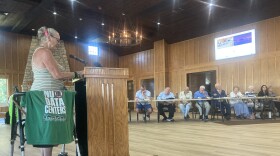
 At the first reading of a proposed data zoning ordinance, residents of Palo and nearby communities raised concerns over the negative impacts future data centers could have on water and traffic, as well as light and noise pollution. Many people asked for the city to tighten regulations, while several others asked the city to table the ordinance completely.


