

Madeleine Charis King
/
Iowa Public Radio
The Des Moines City Council voted 6-1 to approve a proposed budget for fiscal year 2028, which includes service and staffing cuts across departments to balance a significant gap in city funds.

John Pemble
/
Iowa Public Radio

Natalie Krebs
/
Iowa Public Radio
-
 Starting July 1, Iowans will see a host of laws go into effect, including changes to obtaining abortion medication, higher speed limits and new age verification for adult websites.
 -
 A new law that requires Iowans go to an in-person medical appointment in order to obtain abortion medication has gone into effect.
 -
 Gov. Kim Reynolds signed a law Tuesday more than doubling the mandatory minimum sentence for people convicted of a third felony offense, along with two other laws that restrict pretrial release and ban warrant resolution clinics.


-
 Gov. Kim Reynolds signed the state’s first so-called Iowa Farm Act, along with the appropriations bill for agriculture and natural resources. The legislation provides more funding for local food and water treatment plants.
 -
 The University of Iowa Stead Family Children’s Hospital will receive up to $3 million for pediatric cancer research annually, under a bill signed into law Tuesday.
 -
 Gov. Kim Reynolds signed what she called the "Iowa MAHA bill" into law Wednesday with U.S. Health and Human Services Secretary Robert F. Kennedy Jr. by her side.


-
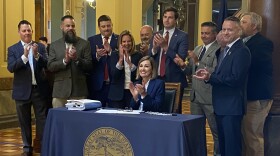 Gov. Kim Reynolds signed a property tax relief bill into law Monday afternoon. Earlier in the day, Des Moines city officials reviewed a looming multimillion budget shortfall in upcoming years due to the property tax changes.
 -
 On this Politics Day, political scientists Donna Hoffman of the University of Northern Iowa and Jonathan Hassid of Iowa State University dissect the debate between Democrat Senate hopefuls Josh Turek and Zach Wahls. They also reflect on the end of the 2026 Legislative session, Vice President J.D. Vance's stop in Iowa to campaign for Rep. Zach Nunn and the Iowa Secretary of State's choice to turn over voter data to the Trump administration.
 -
The 2026 Legislative session has ended after a marathon weekend. Journalists who covered the statehouse share what passed, failed and what is already Iowa law.


