

Madeleine Charis King
/
Iowa Board of Regents/Iowa Public Radio
Iowa's Board of Regents unanimously selected Nebraska professor Carson Holloway to lead the Center for Intellectual Freedom at the University of Iowa, as its outgoing interim director criticized the regents and university administrators' handling of the center.

Neve Kelley
/
Iowa Public Radio

Natalie Krebs
/
Iowa Public Radio
-
 Afghan soldiers stood beside American troops for 20 years. Now, five years after the evacuation, many still don't know if they'll be allowed to stay. On this episode, we take stock of what's happened since roughly one thousand Afghans resettled in Iowa. We talk with Fatima Saidi, national director of We Are All America and Robyn Barnard of Human Rights First. We also discuss what today's shifting immigration rules mean for Afghans still in limbo. Then, we talk with Cate Dicharry, the new director of the University of Iowa's International Writing Program. It’s been a year and a half since federal funding cuts threatened the program, and we discuss what its future holds.
 -
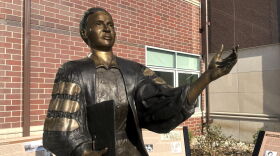 The southeast corner of the Johnson County Administrative Building will become Dr. Lulu Merle Johnson Plaza, featuring a bronze statue of Johnson alongside plaques celebrating Black Iowans in Iowa City.
 -
A fire at Postville's Agri Star meat plant has left hundreds of workers in limbo. On this episode, we talk with 'The Gazette's' Fern Alling about the community's response, and the plant's complicated history. We also hear how camping bans are pushing unhoused Iowans further from the resources they need with the Midwest Newsroom's Nicole Grundmeier. William Morris of the 'Des Moines Register' shares how a retired Iowa State professor wins some $2 million in a landmark equal pay case, and we talk with Vanessa Miller, higher education reporter at 'The Gazette' about new oversight questions at the UI Center for Intellectual Freedom. Then, we hear from IPR's Gavin McGough and Jake DeGroat of the Iowa Climbers Coalition about Iowa's new rock-climbing destination. And IPR Studio One Host Sean McClain grooves us into the weekend.


-
 NASA is partnering with the University of Iowa, Cedar Rapids, Iowa City and Des Moines Water Works to create a new tool to forecast water quality conditions. The goal is to combine satellite imagery with water quality monitors across the state to predict when nitrate concentrations in surface or ground water will reach dangerous levels.
 -
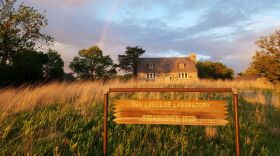 Construction is underway on a new Innovation and Discovery Lab at Iowa Lakeside Laboratory that will expand hands-on learning for students of all ages. The new space will also support research to better understand and protect the water quality of the Iowa Great Lakes.
 -
 On this episode, it's summer school! We talk about the summer slide with University of Iowa expert Leah Zimmermann. The University of Iowa launched a literacy hub to help caregivers develop literacy skills whether at home or on the move. We also hear from Kathleen Locher, an elementary teacher librarian in Iowa City. She shares how a book that hadn’t been checked out in a decade has had a profound impact on her students. We hear poems read by rising fourth-grade Poetry Invaders Lina Ahmed, Sadie Linder, Kate Fina and Etta Schons. Then, Iowa State’s University Museums announced its new director, David Schmitz. We talk with him about how he found a passion for supporting other artists and plans for the future at University Museums.


-
 College students spent the past five summers excavating land around the Abbie Gardner Sharp Cabin in Arnolds Park, uncovering artifacts that help tell the story of one of Iowa's most significant historic sites. With the work complete, officials hope the state will preserve the cabin for future generations.
 -
Ten days, a quarter-million miles from Earth and for the first time since 1972, humans flew around the moon. On this archive episode, we hear from three Iowans who were involved in the historic Artemis II mission that was completed on April 11. Madison Tuttle of West Des Moines, Jack Sieleman of Waukee and Alex Brewer of Council Bluffs share about their love of space exploration — whether lifelong or found on the job — and what their roles were in the preparation for and execution of Artemis II. (This show was originally produced April 2026).
-
 The Iowa Board of Regents and the Center for Intellectual Freedom at the University of Iowa have launched the search for its executive director with a job posting and salary range that could put the selected applicant on the same pay level as some university administrators.


