The number of young ospreys in Iowa hit a record in 2025 with at least 58 fledglings. It stems from a decades-long reintroduction effort in the state and a growing number of nests.
Riggs Wilson, a wildlife research specialist with the Iowa Department of Natural Resources (DNR) and contributor to the 2025 Osprey Nesting Report, said the migratory raptors are uniquely adapted to dive into water to catch fish. The birds have a clear, third eyelid called a “nictitating membrane.”
“That protects their eyes when they go into the water,” Wilson said. “They have specialized joints in their wings that allow them to take off straight up out of the water with their fish prey, and then they also have some specialized joints in their talons.”
Osprey nests along Iowa’s waterways are part of the Omaha Nation's oral traditional stories, according to the DNR. However, successful breeding pairs were not documented in the state since European settlement until the DNR and partners brought in young ospreys from Minnesota and Wisconsin between 1997 and 2016.
The reintroduction of ospreys to Iowa was part of a larger effort.
Osprey populations in North America plummeted in the mid-20th century with the rise of DDT, a pesticide that caused thin eggshells and fewer chicks. Banning DDT and similar chemicals in the 1970s, along with human-made nesting sites, helped the raptor rebound.

In 2025, DNR staff and volunteers monitored 70 osprey nests, which Wilson said is 20 more than the year prior and likely due to both greater osprey numbers and more reporting of nests from the public.
Nests are scattered across the state, but they’re largely concentrated in the Des Moines metro, Spirit Lake area and a corridor between Waterloo and Iowa City.
Thirty of the nests were active and successful, meaning at least one of the chicks survived to fledging.
Over 80% of the active nest sites in Iowa last year were on cellular towers. The DNR said it will continue to work with partners to reduce potential conflicts if work must be done on a tower during the nesting season.
The fastest bird in the world
A separate DNR nesting report for peregrine falcons suggests the number of young has remained stable over the last five years.
Volunteers and professional surveyors with the Raptor Resource Project documented a total of 20 nests in 2025. Nineteen were active and produced 28 fledglings, which Wilson and his co-authors said is lower than 2024 but on par with previous years.
Most of the nests were in the eastern half of the state, in cities along Mississippi River bluffs and at energy plants. Since the plants have restricted access, the DNR relies on employees to provide data, noting they often go beyond to support peregrine falcon conservation.
Bob Freeman, at Muscatine Power and Water, convinced the plant to add a nest box.
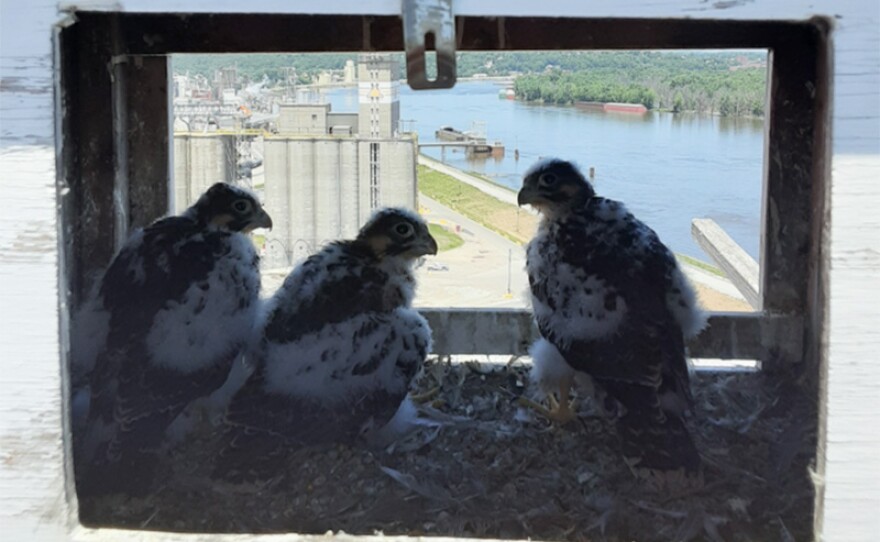

Breeding adults and their nests disappeared from Iowa in the 1950s and dropped low enough in the eastern U.S. to become locally extinct by 1964. Similar to ospreys, they were significantly impacted by DDT.
Iowa’s restoration program began in 1989 with 23 birds released in Cedar Rapids and more reintroductions through 2003. It was part of a regional effort across the Midwest and Great Lakes.
The DNR report said bird flu and other disease threats warrant continued monitoring. While the H5N1 virus largely impacts waterfowl and shorebirds, it can spread to peregrine falcons and eagles that prey on infected birds.
The agency confirmed four peregrine falcon deaths from H5N1 in 2025.
Volunteers are key for monitoring
Wilson said reintroduction programs have played a vital role in establishing nesting populations of ospreys and peregrine falcons in Iowa.
“But then that continued monitoring allows us to know where they're nesting in the state, and if there's any big fluctuations in their nesting,” Wilson said. “None of this would be possible without our amazing volunteers and their dedication.”
Volunteers visit their assigned nests three times throughout the spring and summer, Wilson said. They use spotting scopes to watch for activity over extended periods of time and share their data with the DNR.
The DNR said Iowans interested in monitoring ospreys and peregrines can contact the Volunteer Wildlife Monitoring Program Coordinator by email at: vwmp@dnr.iowa.gov.