

Jared Strong
/
Iowa Capital Dispatch
As agricultural land prices have increased drastically over the past two decades and young, want-to-be farmers have an increasingly difficult time starting their operations, politicians nationally — and here in Iowa — have questioned if corporate or foreign interests are to blame.

Madeleine Charis King
/
Iowa Public Radio

Madeleine King
/
Iowa Public Radio
-
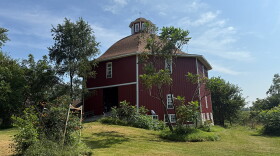 Richard Tyler doesn’t know why he decided to purchase the Secrest Octagonal Barn in 1992; he just knew it was something he wanted to do.
 -
 In 1883, the Secrests commissioned a builder to construct a new barn on their property. The structure is three stories tall with a gothic roof and eight sides. The Iowa Barn Foundation's All-State Barn Tour is Sept. 19-20 and there are a record 108 barns participating. On this episode, we talk with Deann Haden about the Iowa Barn Foundation and highlights for this year's tour. Then, we travel to Cedar County to tour the Secrest 1883 Octagonal Barn with owner Rich Tyler. Later in the hour, we talk with Rachelle Long, founder and executive director of Taste of the Junction, a multicultural festival that celebrates the people and culture of Valley Junction. It takes place Sept. 3-5, and features presentations, live jazz and a street festival.
 -
On this episode, we meet the Lobe Rangers, three Iowa farmers from who are frustrated with how few of their fellow farmers have implemented conservation practices. We learn about their vision for a more sustainable future for Iowa. Then, 'Talk of Iowa' Summer School continues with agriculture teacher Anna Brooks. She makes the farm to table process a focus of her classes.


-
In 1973, Ron Rosmann gave up his plans to go to graduate school and moved back home to Westphalia to run the family farm. In 1973, he did something radical — he stopped using chemical inputs. Rosmann has been farming for more than 50 years, and he's one of the founding members of Practical Farmers of Iowa, a farmer-led community that focuses on sustainable agriculture. He joins us on this episode to talk about his book, 'A Practical Farmer's Journey: A History of Community, Stewardship and Resilience.' We also talk with Steve Hopkins, a member of Practical Farmers of Iowa and an innovator in regenerative agriculture and water conservation.
-
 Lawmakers in 13 states have proposed banning or restricting paraquat, a toxic herbicide that researchers have tied to an increased risk of developing Parkinson's disease. But efforts to outlaw it have failed across the Midwest.
 -
 A new art installation in Des Moines will honor former Des Moines Water Works CEO Bill Stowe, who spent years advocating for better water quality in Iowa. The artwork doubles as an outdoor classroom, where people can learn about the threats to Iowa’s drinking water.


-
 U.S. Geological Survey researchers developed models to better understand the timing and sources contributing to nutrient pollution in streams and rivers. They say their findings can help guide efforts to improve water quality.
 -
 A group of farmers say voluntary approaches to conservation are not delivering the scale of change needed to meet the state’s nutrient reduction goals. They’re calling for a new system of incentives and disincentives.
 -
 Tariffs are squeezing Midwest households. On this episode, we talk about what that means for your grocery bill and Iowa's economy. First, we hear from Frank Manzo of the Midwest Economic Policy Institute on the impact of tariffs on Midwest household costs, manufacturing jobs and the GDP. Then, Ben Murrey of the Common Sense Institute offers his read on our economic outlook. He shares his insight on recent jobs and inflation, and manufacturing’s outsized contributions in Iowa. We also talk with Kyle McMahon of Tractor Zoom, who turned used-tractor pricing into a business.


